Wednesday, April 27, 2016

Fallout: A Nuclear Romance (Part 3)


By Cailin Reedy


The result of a player in Bethesda's "Fallout 4" using the Fat Man mini nuke launcher as a weapon.


Bethesda’s “Fallout” universe has been developed for more than 20 years. It is a pseudo-1960s society set more than a hundred years in the future. This universe never invented the transistor to enter into the digital age, but they advanced nuclear power to a point that most of their technology relied on it. The gasoline was almost used up, to the point that one gallon of gas cost in excess of $6,000.

But one of the most striking propositions of the “Fallout” universe’s alternate timeline is the effects of radiation on the larger world. Dr. Michael J. Mills, a National Center for Atmospheric Research scientist, and his colleagues published a study in 2014 looking at the potential consequences of a nuclear war between Pakistan and India. This hypothetical war would use less than 1 percent of the world’s nuclear weapons.

The study found that although much of the “Fallout” universe’s mythology is nothing more than souped-up and “cool” fictional hypotheticals, there is some basis in fact. Mills’ study used 100 hypothetical 15-kiloton bombs, the same size as “Little Boy” that was dropped on Hiroshima near the end of World War II.

The study found that such a nuclear assault would be devastating, creating supermassive firestorms that could consume entire cities. These firestorms would release up to 5 million tons of carbon into the atmosphere, destroying the ozone layer up to 50 percent in some places. The resulting nuclear winter would drop temperatures by up to 46 degrees, shortening crop growing seasons and leading to the starvation of billions of people. At the end of the nuclear winter, which could last 30 years, Mills doubted if any humans would have survived.

And that’s using less than 1 percent of the world’s nuclear weapons—100 15-kiloton missiles. In “Fallout” canon, Las Vegas alone was the target of 77 nuclear warheads, the average size of which is stated to be between 200 and 750 kilotons.

While “Fallout” may seem to present a bleak future should nuclear warheads be loosed, the reality is much, much more deadly.

Environmentalism in the Digital Age


By Cailin Reedy


The advent of social media has increased communication between the average person and the wider outside world. With applications such as Facebook, Twitter and Yik Yak, people can easily (and sometimes anonymously) voice their thoughts to huge numbers of people. The reach of the average person has been increased exponentially.

But while a singular unknown Twitter user’s observations might reach hundreds or even thousands of people because of sharing and re-tweeting, other issues have arisen. On social media, one popular method of practicing activism has arisen. Its roots lie in the sharing, re-tweeting and “liking” community on places like Twitter and Facebook.

The rationalization goes like this: Increasing awareness is on the same level as actually doing something physically to aid the effort. In some ways, it could be, especially if the mission is to spread information and change opinions. But for a mission that relies on people doing something to make a change, sharing something on social media most likely won’t do much.

However, while social media activism may present the problem that people only like, share or re-tweet, it also means that ideas are reaching more people more quickly. Sabrina Khan-Ibarra, a writer for the Huffington Post, insists that social media is an important tool in an activist’s arsenal. Without social media, Khan-Ibarra argues, the common person wouldn’t have a chance to speak out when large news outlets refuse to cover an issue.

In environmentalism, this kind of grassroots activism comes into the spotlight in response to big things. It has to be timely for people to care, like a big tree being cut down or a new, devastating law being passed. But people will rally around social media. It’s a new form of rallying and protesting, not physically but in the digital realm.

The Lorax's Message

By Cailin Reedy


Since the Industrial Revolution, big industry has effectively steamrolled the natural environment - sometimes literally. Though activist groups sometimes try to fight back against the forces of industry, their efforts to protect the natural environment aren’t always given a chance to succeed.

In Dr. Seuss’ “The Lorax,” a cautionary tale about the dangers of overindustrialization, a sad old man called the Once-ler tells the tale of the Lorax, the guardian of the forest. The Once-ler was an industrialist who, by chopping down the trees, gained a material he could use to produce any item humanity could want for. But his ambition became toxic to the environment, and he didn’t stop until the last tree was cut down and the forest had become a barren wasteland. The Once-ler then gives his listener the last tree seed and tells him to plant it.

In the 2012 film of the same name, the Once-ler and the Lorax have a more complicated relationship. The Once-ler had tried to harvest the trees sustainably, but the process was slow and production was limited by the harvest times of the trees. His family pressured him to produce more, and dispite a promise to the Lorax and a friendship with the forest guardian, he gave in to his family’s pressure. When the forest was used up, his family disowned him for his failure to continue producing materials, and the Lorax led the forest animals away. But thanks to a boy (Ted in the movie, named for Dr. Seuss), the Once-ler is able to pass on the last tree seed and have it planted. Eventually the Lorax and his animal friends return, and the Once-ler is redeemed.

The film has a happier ending than the original book, which leaves readers with an uncertain future: Will the boy plant the seed, or will the land continue to rot because of its exploitation? This uncertainty about the future is more realistic.

However, “The Lorax” has become an emblem of environmentalism since its creation in 1971. It serves not only as a cautionary tale, but also as a catalyst for people to do more for the environment. However bleak the future may seem in the book, the film shows viewers that there might always be a chance for recovery. We can only hope that society doesn’t take the damage of the environment to such an extreme before taking action to reverse it. An ounce of prevention is, after all, worth a pound of cure.

Monday, April 4, 2016

Fallout: A Nuclear Romance (Part 2)

By Cailin Reedy


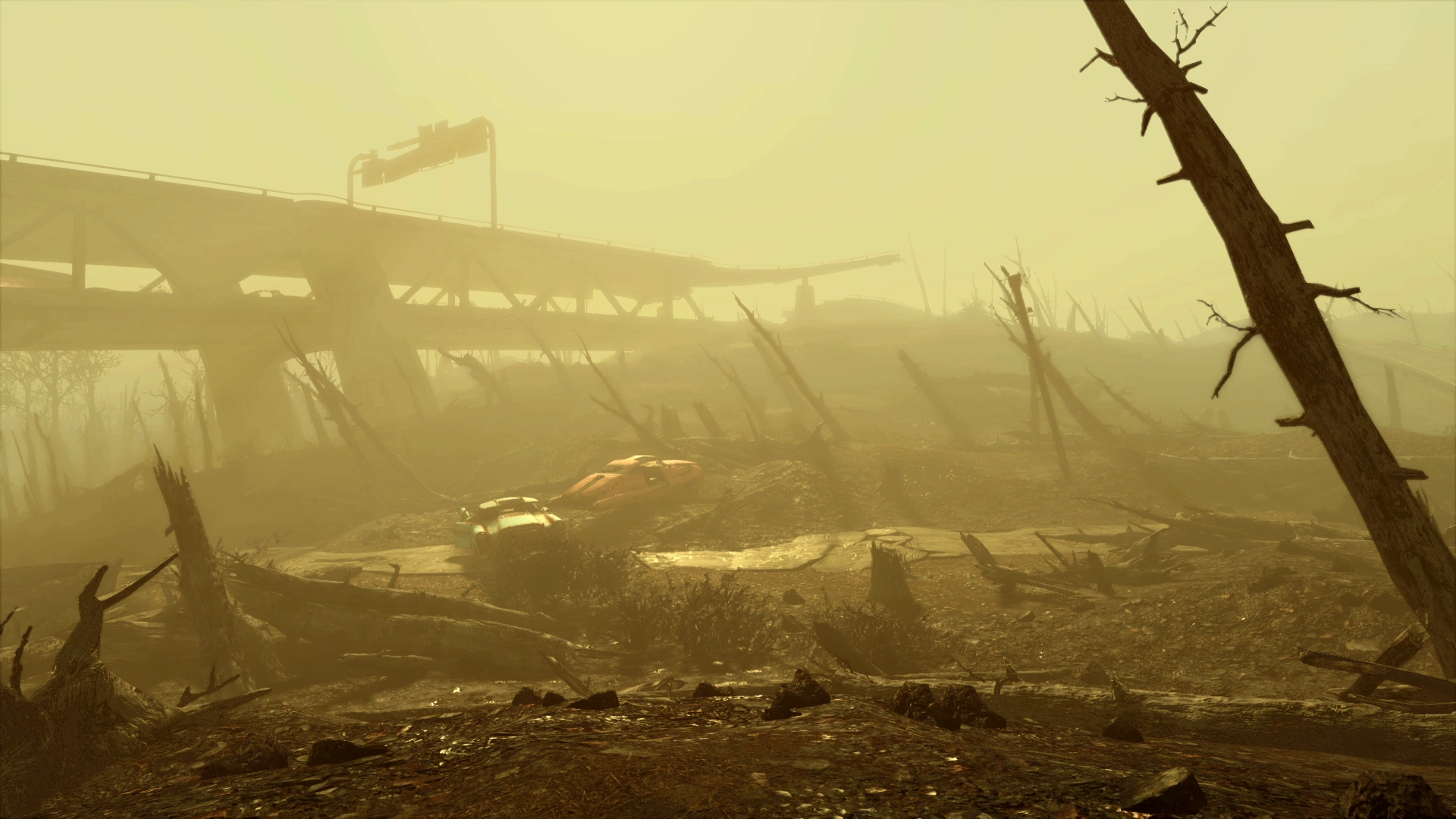
The radioactive Wasteland outside of Boston in Bethesda's Fallout 4.


As I’ve previously discussed, people tend to have a weird fascination with the apocalypse as discussed in the media.  Unless it’s discussed in realistic terms, the apocalypse is just something to be beaten, a chance for the heroes to come in guns blazing and rescue the world from certain death.  But even when it is discussed seriously, the end of the world is often laughed off as fiction.

In Bethesda’s "Fallout" series, the apocalypse has already happened and players must navigate an irradiated wasteland full of collapsed buildings and mutant creatures.  But the pseudo-'60s mentality, eerily upbeat and accepting of the end of the civilized world, is dissonant.  The non-player characters live hard-scrabble lives, fighting to survive each day in the Wasteland.

But one of the more disturbing insinuations has to do with the science fiction treatment of nuclear warfare.

Of course, if a nuclear bomb on the levels of Little Boy or Fat Man, the bombs dropped on Hiroshima and Nagasaki during World War Two, were to be dropped on almost any part of America, the blast radius and subsequent nuclear fallout in the area would be devastating.  Predictions of how a nuclear blast would play out can be made with the NUKEMAP tool created by Alex Wellerstein.  NUKEMAP allows a user to input data, such as nuclear bomb yield and point of impact, in order to generate potential casualties, radioactive fallout, and nuclear drift due to air and water currents.

However, video games such as "Fallout" give players the wrong idea about nuclear energy.  While it can be used to make bombs of devastating effect, nuclear energy can also be used as a clean, non-invasive way to power cities without further polluting the environment.  It is both potentially helpful and harmful, but video games such as "Fallout" hit upon only the harmful side of it—a radioactive future wasteland where radiation kills and mutates.

Monday, March 28, 2016

Fallout: A Nuclear Romance (Part 1)


By Cailin Reedy


A male hero and his companion Dogmeat set out for the Commonwealth's wasteland in Bethesda's "Fallout 4."

The "Fallout" series is perhaps one of the most expansive open-world video game franchises in existence. Its virtual maps span more than half of the United States, allowing players to explore vast expanses of the irradiated American wilderness and the settlements that have sprung from broken 1960s cityscapes.

As I’ve noted before, our culture has a weird fascination with the apocalypse, especially the apocalypse as a leveling factor that facilitates adventure and heroism. But the environmental impact isn’t something that’s often readily discussed among such fan bases, especially in a video game series such as "Fallout" where radiation damage can be easily mitigated through medicine. Disturbingly mutated humans and animals are a common occurrence in the Wasteland.

The newest game in the franchise, "Fallout 4," is no exception.  It takes place in an area called the Commonwealth, or what used to be the cities of Boston and Cambridge, Massachusetts. "Fallout 3" included the nearby Capital Wasteland, the irradiated remains of Washington D.C. and its surrounding territories. Like the other games, "Fallout 4" contains a huge variety of Atomic Age science fiction tropes as well as postmodern takes on such ideas.

But the idea that nuclear warfare is cool endures. The apocalypse is not something to prevent in such games, unless it suits the player’s whims to keep the Wasteland from becoming any worse over the course of the game. The natural environment is already ruined, and though at key points in the game the player may be given some sway over whether general living conditions become worse in the area, the damage is already done. In some cases, such as in a recent update, players can even further destroy the environment.

With the endurance of a franchise built on the smoldering ruins of a postmodern nuclear wasteland, it’s doubtful that environmentalism will enter into "Fallout" any time soon.

Monday, March 21, 2016

Back to the Earth with WALL-E


By Cailin Reedy

Many environmental films take the form of documentaries on the given subject. They usually run between one and three hours in length. They feature a single problem or group of people to focus in-depth on a single scenario. And they tend to follow similar patterns: here is a problem, here is how we fix it and here is what happens if we’re too late. Viewers who aren’t interested in hearing such dire prognoses for the planet might not be interested in watching them.

But alternatives to such depressing environmental documentaries do exist, and according to technology magazine Wired, one of the “most powerful” environmental films of the 2000s is a Disney animated movie.

The film is "WALL-E," and it is anything but depressing. The plot centers around a steward robot, named WALL-E (or Waste Allocation Load Lifter Earth-class), left behind on a post-apocalyptic Earth to collect trash and junk. After he meets another robot, EVE (Extraterrestrial Vegetation Evaluator), the two discover a seedling growing on the barren planet. Eventually, because they believe the planet has healed itself after extensive pollution and warfare, humans return to Earth and find it still largely barren.

“It looks like Earth. But where’s the blue sky? Where’s the grass?” one character, the human captain of the spaceship, remarks when the crew makes landfall. That question encompasses the theme of the film: people have an “ideal” vision of what Earth and nature should be, but many are still unmotivated when it comes to keeping Earth in such a state, especially if it takes more than a bit of easy work.

It’s not only Wired that believes "WALL-E" to be effective on the environmental front. TIME Magazine named "WALL-E" the “Best Movie of the Decade,” though Disney and Pixar continue to disavow the film’s environmental implications. But even if Disney doesn’t want to officially step on any toes, the film's message continues to speak for itself. And it may be the hopeful message people need to start changing for the better.

Monday, March 14, 2016

The Environment After Tomorrow


By Cailin Reedy

Buildings collapse in 2012 as a result of global natural disaster.

America loves the apocalypse. Movies like "The Day After Tomorrow" and "2012" describe the potential consequences of environmental disaster: volcanoes erupt, ice storms cover New York, and half of California falls into the ocean. But these consequences might not be as far-fetched as we think.

According to research conducted by the University of Southampton, global warming could actually cause a period of falling temperatures if it occurs in tandem with a collapse of the Atlantic meridional overturning circulation. The AMOC is the ocean current that forces cold water southward and warm water to the north. The research used the state-of-the-art climate model ECHAM at the Max-Planck Institute in Hamburg, Germany.

In "The Day After Tomorrow," global warming and the AMOC collapse kick off intense and immediate global change, including a violent freeze-over of the entire northern hemisphere. In "2012," the Yellowstone supervolcano erupts and begins a chain of freak natural accidents: super tidal waves overturn cruise liners out at sea, earthquakes destroy the west coast, mountains shift and billions of people die.

But the realistic predictions are much less dramatic. Research found that if such a collapse occurred in tandem with global warming, the Earth would cool for 20 years. Global warming would continue as normal, but with an offset of -33.44 degrees Fahrenheit. The Earth would return to normal temperatures within 40 years, the research predicted, but the area near the eastern boundary of the North Atlantic would take up to a century to return to normal.

Although the real changes might not be as dramatic as the movies would have us believe, these cinematic predictions aren’t as wild as we think. Even the most far-fetched environmental action flick has its basis in science. And unless people around the world change what we can for the better, someday we’ll be faced with the reality of the day after tomorrow.