Wednesday, April 27, 2016

Fallout: A Nuclear Romance (Part 3)


By Cailin Reedy


The result of a player in Bethesda's "Fallout 4" using the Fat Man mini nuke launcher as a weapon.


Bethesda’s “Fallout” universe has been developed for more than 20 years. It is a pseudo-1960s society set more than a hundred years in the future. This universe never invented the transistor to enter into the digital age, but they advanced nuclear power to a point that most of their technology relied on it. The gasoline was almost used up, to the point that one gallon of gas cost in excess of $6,000.

But one of the most striking propositions of the “Fallout” universe’s alternate timeline is the effects of radiation on the larger world. Dr. Michael J. Mills, a National Center for Atmospheric Research scientist, and his colleagues published a study in 2014 looking at the potential consequences of a nuclear war between Pakistan and India. This hypothetical war would use less than 1 percent of the world’s nuclear weapons.

The study found that although much of the “Fallout” universe’s mythology is nothing more than souped-up and “cool” fictional hypotheticals, there is some basis in fact. Mills’ study used 100 hypothetical 15-kiloton bombs, the same size as “Little Boy” that was dropped on Hiroshima near the end of World War II.

The study found that such a nuclear assault would be devastating, creating supermassive firestorms that could consume entire cities. These firestorms would release up to 5 million tons of carbon into the atmosphere, destroying the ozone layer up to 50 percent in some places. The resulting nuclear winter would drop temperatures by up to 46 degrees, shortening crop growing seasons and leading to the starvation of billions of people. At the end of the nuclear winter, which could last 30 years, Mills doubted if any humans would have survived.

And that’s using less than 1 percent of the world’s nuclear weapons—100 15-kiloton missiles. In “Fallout” canon, Las Vegas alone was the target of 77 nuclear warheads, the average size of which is stated to be between 200 and 750 kilotons.

While “Fallout” may seem to present a bleak future should nuclear warheads be loosed, the reality is much, much more deadly.

Environmentalism in the Digital Age


By Cailin Reedy


The advent of social media has increased communication between the average person and the wider outside world. With applications such as Facebook, Twitter and Yik Yak, people can easily (and sometimes anonymously) voice their thoughts to huge numbers of people. The reach of the average person has been increased exponentially.

But while a singular unknown Twitter user’s observations might reach hundreds or even thousands of people because of sharing and re-tweeting, other issues have arisen. On social media, one popular method of practicing activism has arisen. Its roots lie in the sharing, re-tweeting and “liking” community on places like Twitter and Facebook.

The rationalization goes like this: Increasing awareness is on the same level as actually doing something physically to aid the effort. In some ways, it could be, especially if the mission is to spread information and change opinions. But for a mission that relies on people doing something to make a change, sharing something on social media most likely won’t do much.

However, while social media activism may present the problem that people only like, share or re-tweet, it also means that ideas are reaching more people more quickly. Sabrina Khan-Ibarra, a writer for the Huffington Post, insists that social media is an important tool in an activist’s arsenal. Without social media, Khan-Ibarra argues, the common person wouldn’t have a chance to speak out when large news outlets refuse to cover an issue.

In environmentalism, this kind of grassroots activism comes into the spotlight in response to big things. It has to be timely for people to care, like a big tree being cut down or a new, devastating law being passed. But people will rally around social media. It’s a new form of rallying and protesting, not physically but in the digital realm.

The Lorax's Message

By Cailin Reedy


Since the Industrial Revolution, big industry has effectively steamrolled the natural environment - sometimes literally. Though activist groups sometimes try to fight back against the forces of industry, their efforts to protect the natural environment aren’t always given a chance to succeed.

In Dr. Seuss’ “The Lorax,” a cautionary tale about the dangers of overindustrialization, a sad old man called the Once-ler tells the tale of the Lorax, the guardian of the forest. The Once-ler was an industrialist who, by chopping down the trees, gained a material he could use to produce any item humanity could want for. But his ambition became toxic to the environment, and he didn’t stop until the last tree was cut down and the forest had become a barren wasteland. The Once-ler then gives his listener the last tree seed and tells him to plant it.

In the 2012 film of the same name, the Once-ler and the Lorax have a more complicated relationship. The Once-ler had tried to harvest the trees sustainably, but the process was slow and production was limited by the harvest times of the trees. His family pressured him to produce more, and dispite a promise to the Lorax and a friendship with the forest guardian, he gave in to his family’s pressure. When the forest was used up, his family disowned him for his failure to continue producing materials, and the Lorax led the forest animals away. But thanks to a boy (Ted in the movie, named for Dr. Seuss), the Once-ler is able to pass on the last tree seed and have it planted. Eventually the Lorax and his animal friends return, and the Once-ler is redeemed.

The film has a happier ending than the original book, which leaves readers with an uncertain future: Will the boy plant the seed, or will the land continue to rot because of its exploitation? This uncertainty about the future is more realistic.

However, “The Lorax” has become an emblem of environmentalism since its creation in 1971. It serves not only as a cautionary tale, but also as a catalyst for people to do more for the environment. However bleak the future may seem in the book, the film shows viewers that there might always be a chance for recovery. We can only hope that society doesn’t take the damage of the environment to such an extreme before taking action to reverse it. An ounce of prevention is, after all, worth a pound of cure.

Monday, April 4, 2016

Fallout: A Nuclear Romance (Part 2)

By Cailin Reedy


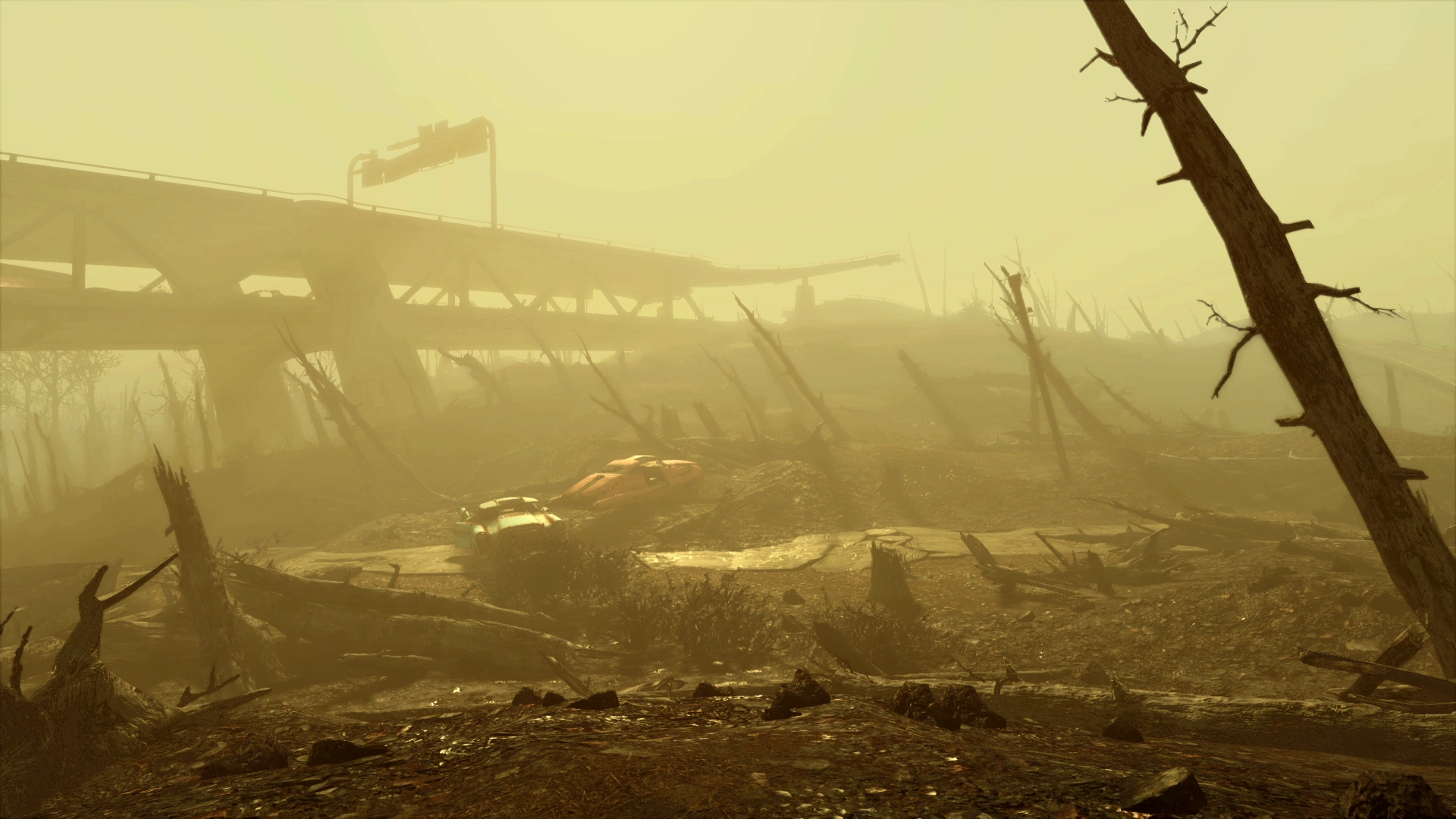
The radioactive Wasteland outside of Boston in Bethesda's Fallout 4.


As I’ve previously discussed, people tend to have a weird fascination with the apocalypse as discussed in the media.  Unless it’s discussed in realistic terms, the apocalypse is just something to be beaten, a chance for the heroes to come in guns blazing and rescue the world from certain death.  But even when it is discussed seriously, the end of the world is often laughed off as fiction.

In Bethesda’s "Fallout" series, the apocalypse has already happened and players must navigate an irradiated wasteland full of collapsed buildings and mutant creatures.  But the pseudo-'60s mentality, eerily upbeat and accepting of the end of the civilized world, is dissonant.  The non-player characters live hard-scrabble lives, fighting to survive each day in the Wasteland.

But one of the more disturbing insinuations has to do with the science fiction treatment of nuclear warfare.

Of course, if a nuclear bomb on the levels of Little Boy or Fat Man, the bombs dropped on Hiroshima and Nagasaki during World War Two, were to be dropped on almost any part of America, the blast radius and subsequent nuclear fallout in the area would be devastating.  Predictions of how a nuclear blast would play out can be made with the NUKEMAP tool created by Alex Wellerstein.  NUKEMAP allows a user to input data, such as nuclear bomb yield and point of impact, in order to generate potential casualties, radioactive fallout, and nuclear drift due to air and water currents.

However, video games such as "Fallout" give players the wrong idea about nuclear energy.  While it can be used to make bombs of devastating effect, nuclear energy can also be used as a clean, non-invasive way to power cities without further polluting the environment.  It is both potentially helpful and harmful, but video games such as "Fallout" hit upon only the harmful side of it—a radioactive future wasteland where radiation kills and mutates.